
Cobot Welding for Small Batches: Getting Started
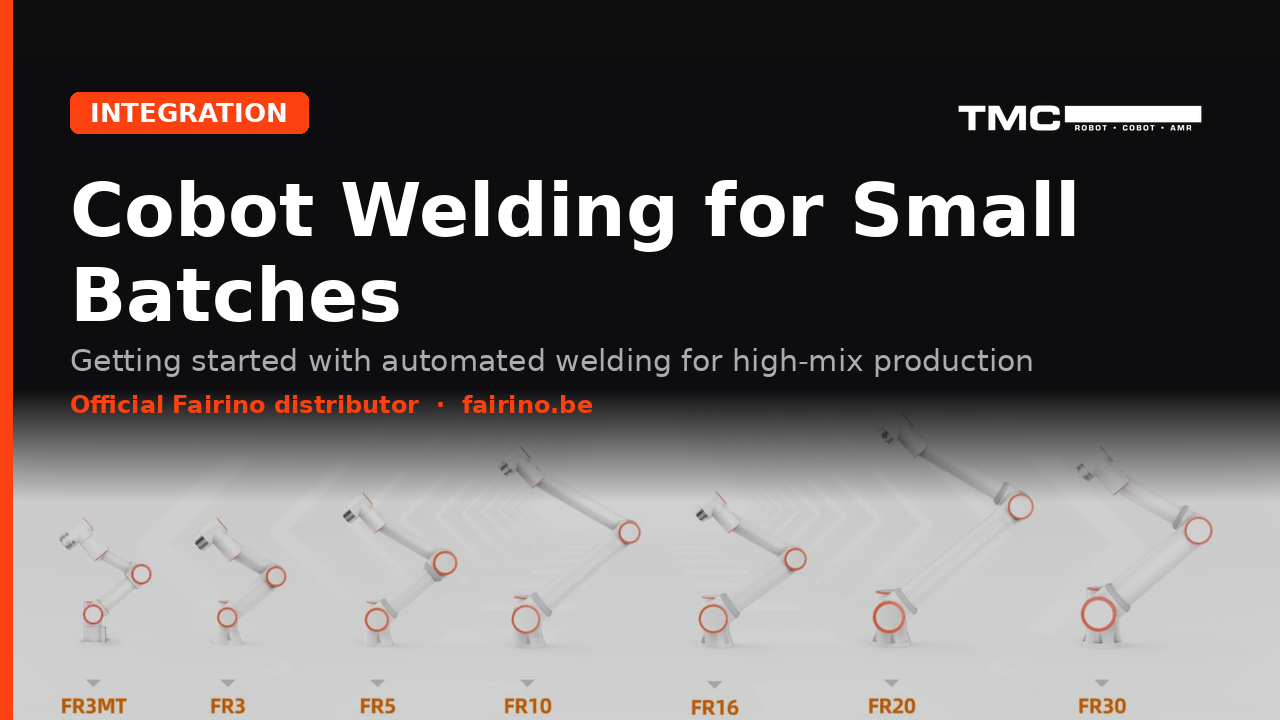
Cobot Welding for Small Batches: Getting Started
Skilled welders are retiring faster than new ones enter the trade, and nowhere is that felt harder than in job shops and fabricators running small batches. Traditional welding robots never solved this problem. They need fencing, offline programming and long production runs before the investment pays off. Cobot welding changes that equation. A collaborative robot with a welding torch can be programmed on the shop floor in minutes, wheeled between workstations, and still lay down a more consistent bead than a tired human hand at four in the afternoon. This guide covers getting started with cobot welding for small batch production: what the cell looks like, how the torch and power source work together, and what to watch out for.
Why Cobot Welding Fits High-Mix, Low-Volume Production
A conventional robotic welding cell is built around one assumption: you will weld the same part thousands of times. The robot is bolted down, programmed offline by a specialist, and surrounded by hard guarding. That model collapses when your typical order is 5 to 50 pieces, because programming time eats the entire batch.
Cobot welding flips the economics for small batches:
- Programming in minutes, not days. You guide the torch to the start and end of each seam by hand, set the welding parameters, and press play. For a simple bracket that can take less than 15 minutes.
- Your welder becomes the programmer. No robotics engineer needed. The person who knows how the joint should be welded teaches the cobot, which keeps that knowledge in your company.
- Small footprint and mobility. A cobot on a cart or compact welding table can be moved to the work, or stored away when a manual job comes in.
- Consistency on every part. The cobot holds the same travel speed, torch angle and stickout on part 1 and part 50, which means less rework and grinding.
- Lower investment. A complete cobot welding package typically costs a fraction of a traditional robotic welding cell, which shortens the payback period at low volumes.
The result: batches that were never worth automating suddenly are, and your scarce welders spend their time on the complex one-off work where their skill actually matters.
What Is in a Cobot Welding Cell?
A typical small batch cobot welding cell consists of a handful of building blocks:
- The cobot arm. For welding you want enough reach to cover your typical weldments without repositioning. A mid-size cobot such as the Fairino FR10 is a common choice; for larger frames a longer-reach model like the FR16 gives extra margin. Browse the full range on our products page.
- The welding power source. Most cobot welding is MIG/MAG. Modern inverter power sources with synergic lines pair well with a cobot because one signal can select a complete parameter set.
- Torch, bracket and cable management. A robot-ready torch neck mounts to the cobot flange with an insulated bracket. Route the torch cable and gas hose with enough slack for wrist rotation, but tight enough that they never snag.
- Welding table and fixtures. A slotted welding table with modular clamps is the backbone of repeatability. If the part sits in the same place every time, the program just works.
- Fume extraction and screens. An extraction arm or torch-integrated extraction, plus welding screens to protect people nearby from arc glare.
Torch and Power Source Integration
The cobot and the power source talk to each other through a small set of signals, and getting this handshake right is most of the integration work:
- Arc start and stop. A digital output from the cobot controller triggers the arc, exactly like pulling the torch trigger.
- Parameter selection. Voltage, wire feed speed and current are set either through analog signals, through job numbers stored in the power source, or through a digital bus connection such as Modbus.
- Arc established feedback. The power source reports back that the arc is burning, so the cobot only starts moving when the weld has actually started.
- Gas pre-flow and post-flow, crater fill and wire stick detection are handled by the power source and simply sequenced by the cobot program.
An open cobot controller with accessible digital and analog I/O plus Modbus makes this integration a wiring job rather than a software project. That openness is one of the reasons cobot welding cells come together in days.
Programming Your First Weld
Programming a weld on a cobot follows a simple pattern:
- Clamp the part and hand-guide the torch to the seam start. Save the point.
- Guide it along the joint and save the end point. For a straight seam two points are enough; for curves you add intermediate points or an arc move.
- Set the work angle and travel angle the way you would hold the torch yourself, and keep the stickout constant.
- Pick the welding parameters: material, wire diameter, gas and plate thickness determine your synergic line or job number, plus a travel speed.
- Run a dry run without the arc first. Then weld a test piece and adjust travel speed and parameters until the bead is right.
Save proven parameter sets as templates per material and thickness combination. After a few weeks you will have a library that turns programming a new small batch into a ten minute job. If you want to go further, weave patterns for wider gaps and scripting for repeated seam patterns are the next step up.
Handling Part Variation: Fixtures, Touch Sensing and Seam Tracking
Small batch work often means parts that are sawn, sheared or bent with generous tolerances. A robot does not improvise the way a human welder does, so you manage variation in three layers:
- Fixturing first. A good clamp that locates the part against fixed stops removes most variation at zero ongoing cost. This is the highest-return investment in the whole cell.
- Touch sensing. The cobot probes the part with the wire or gas nozzle before welding and shifts the program to match where the part actually sits. This costs a few seconds per part and handles placement variation well.
- Seam tracking. For long seams on parts that distort with heat, arc-based seam tracking measures the arc signal during welding and corrects the path in real time. It is powerful, but for many small batch jobs good fixtures plus touch sensing are enough, so do not buy complexity you do not need.
Safety, Fumes and Arc Glare
Here is the thing about cobot welding safety: the welding process is more hazardous than the robot. Even though a collaborative robot is designed to work near people, the arc, the fumes, the hot parts and the UV radiation are not collaborative at all. Your risk assessment must cover the application, not just the arm.
In practice a cobot welding cell uses welding screens or curtains against arc glare, fume extraction at the source, and clear rules about where the operator stands during welding. Many cells add area monitoring, for example with a safety laser scanner, to slow or stop the cobot when someone approaches while the arc is on. The good news: this is all standard, well understood equipment, and a supplier who knows cobots will help you specify it correctly.
What Does Cobot Welding Cost?
A cobot welding cell is typically a mid five-figure investment depending on the power source, table, extraction and options you choose. That is well below a traditional robotic welding cell, and the payback logic is different too: you are not chasing cycle time on one part, you are freeing up scarce welder hours across many jobs.
The savings come from three places: welder time released to complex work, less rework thanks to consistent quality, and the ability to quote work you previously had to refuse for lack of capacity. Shops that keep the cobot busy for a meaningful part of the day usually see payback in one to two years. Want numbers for your situation? Request a quote and we will size a cell with you.
A Real Example
This is not theory. One of our customers runs a Fairino based cobot welding cell for exactly this kind of high-mix production, welding small series with one operator supervising the process instead of holding the torch all day. You can see that project and others on our cases page.
Getting Started: A Practical Checklist
- Pick a first product family: recurring small batches, simple joint types, steel before exotic materials.
- Check reach and access: can one cobot position cover all seams with the part clamped once?
- Choose a robot-ready power source with synergic programs and a digital interface.
- Invest in a slotted welding table and modular clamping before anything fancy.
- Plan fume extraction and screens from day one.
- Do the risk assessment for the welding application, not just the robot.
- Train your welder as the cobot operator and let them build the parameter library.
- Measure released welder hours and rework rate so you can prove the ROI.
Frequently Asked Questions
Can a cobot weld as well as a human welder?
On repeatable seams a cobot welds more consistently than a human, because travel speed, angle and stickout never drift. A skilled welder still wins on complex one-off joints, difficult positions and improvisation, which is exactly the work your welders keep doing.
Which welding processes work with a cobot?
MIG/MAG is the standard for cobot welding and the easiest to start with. TIG is possible for higher-end work but is slower and demands more of fixturing and wire feeding. Most small batch shops start with MIG/MAG.
Do I still need a welder to operate the cell?
Yes, and that is a feature. The best cobot welding cells are run by welders who know what a good bead looks like. The cobot removes the repetition, not the craft.
Is cobot welding safe without a fence?
That depends on the risk assessment of the full application. The arm may be collaborative, but arc glare, fumes and hot parts still require screens, extraction and sensible working procedures. Many cells combine a cobot with area monitoring instead of hard fencing.
Thinking about automating your welding? We help small batch manufacturers across the Benelux specify and build cobot welding cells around the Fairino range. Request a quote or contact us for advice on sizing, torch integration and your first application.
