
Cobot brands compared (2026): Fairino vs UR, Doosan, Techman, JAKA, AUBO & Elite
Picking a cobot gets a lot easier once you compare the brands on the same terms. Below we line up the best known cobot makers on payload, reach, repeatability and country of origin, using each manufacturer's published specifications. The goal is a fair overview so you can build a shortlist. We are not crowning a winner, because the right cobot depends on your application, your budget, and the support you can actually get near you.
The main cobot brands in 2026
The market splits into roughly three groups. The European and American pioneers, so mainly Universal Robots. The Korean and Taiwanese players, Doosan and Techman. And a fast growing group of Chinese manufacturers: Fairino, JAKA, AUBO and Elite Robots. They all build 6 axis collaborative arms meant to work safely next to people.
Universal Robots (Denmark)
The pioneer of the category. The e-Series (UR3e, UR5e, UR10e, UR16e) and the newer UR20 and UR30 cover roughly 3 to 30 kg and 500 to 1750 mm, with repeatability around ±0.03 to ±0.1 mm depending on the model. Their ecosystem (UR+) and integrator network are mature and widely respected. On price they sit at the premium end.
Doosan Robotics (South Korea)
A broad line up. The M series (the M1013 does 10 kg over 1300 mm at ±0.05 mm), the heavier H series (the H2017 does 20 kg over 1700 mm at ±0.1 mm) up to 25 kg, and the fast A series. Known for good payload to reach options and strong safety features.
Techman Robot (Taiwan)
Techman puts a camera in every model. The range runs from the TM5 up to the TM25S, which does 25 kg over 1902 mm at ±0.03 mm. A good fit when vision and inspection sit at the heart of the application.
Fairino (China, Suzhou)
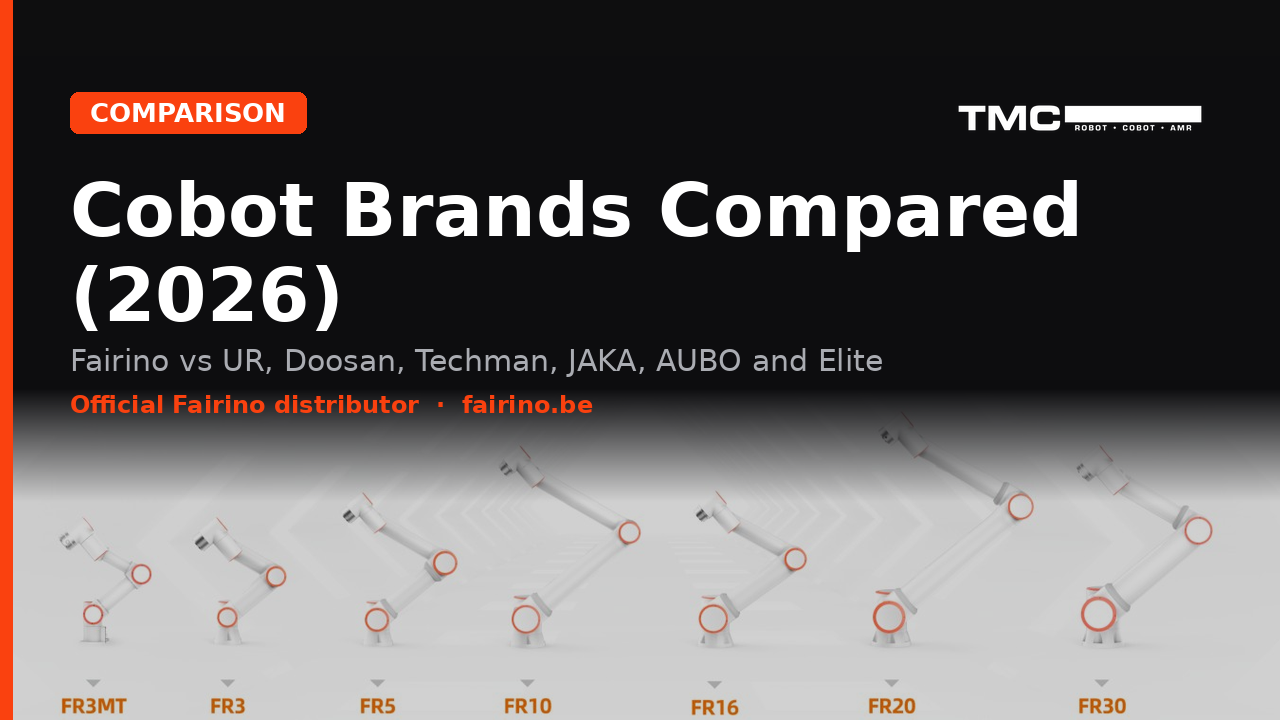
The FR series runs from the FR3 to the FR30, so 3 to 30 kg, 622 to 1854 mm, and ±0.02 to ±0.1 mm repeatability depending on the model. What stands out is licence free software with open SDKs (Python, C++, C#, Java, Lua, ROS and ROS2) and a low entry price. The FR3 starts at €4,600 excl. VAT. In Europe, Fairino is distributed by TMC Robotics (fairino.be), with stock in Belgium.
JAKA (China, Shanghai)
The Zu series runs from the Zu3 up to the heavy Zu20 and Zu30, so 3 to 30 kg and 626 to 1780 mm, with ±0.02 to ±0.05 mm repeatability. Known for a clean, app style interface.
AUBO (China, Beijing)
The i series (i3, i5, i10, i16, i20) covers 3 to 20 kg and 625 to 1650 mm at ±0.02 to ±0.1 mm. The newer iS series goes up to 35 kg. Positioned as an open, ROS friendly platform.
Elite Robots (China, Shanghai)
The CS series, from the CS63 to the new CS530H, covers 3 to 30 kg and 624 to 1800 mm at ±0.02 to ±0.1 mm, with IP65 as standard and IP68 as an upgrade. Elite makes a point of its stated reliability figures (MTBF).
Specification overview
Approximate ranges across each brand's current line up. Always check the datasheet for the exact figures of a specific model.
| Brand | Origin | Payload | Reach | Repeatability |
|---|---|---|---|---|
| Fairino (FR series) | China | 3 to 30 kg | 622 to 1854 mm | ±0.02 to ±0.1 mm |
| Universal Robots (e-Series, UR20, UR30) | Denmark | 3 to 30 kg | 500 to 1750 mm | ±0.03 to ±0.1 mm |
| Doosan (M, H, A) | South Korea | up to 25 kg | up to 1700 mm | ±0.05 to ±0.1 mm |
| Techman (TM, TM S) | Taiwan | up to 25 kg | up to 1902 mm | ±0.03 to ±0.1 mm |
| JAKA (Zu) | China | 3 to 30 kg | 626 to 1780 mm | ±0.02 to ±0.05 mm |
| AUBO (i series) | China | 3 to 20 kg | 625 to 1650 mm | ±0.02 to ±0.1 mm |
| Elite Robots (CS) | China | 3 to 30 kg | 624 to 1800 mm | ±0.02 to ±0.1 mm |
How to choose
- Payload and reach. Start from the weight of your part plus the gripper, and the distance the arm has to cover. That alone knocks out half the field.
- Repeatability. Most brands land between ±0.02 and ±0.1 mm. Tighter matters for precision assembly, much less for palletizing.
- Software and openness. Is the programming done in a browser or on a teach pendant, are the SDKs open, and are there licence fees? Open platforms keep you out of a lock in.
- Local support and availability. Probably the biggest real world factor. Who delivers, who keeps stock, who trains your team, and who picks up the phone when a line is down. A great cobot with no local support is a risk.
- Total cost. Look past the arm price at software licences, accessories, integration and lead time.
Where Fairino fits
Fairino competes on a low entry price, licence free open software and a full 3 to 30 kg range. That is why it appeals to first time cobot buyers and to integrators who want to avoid licence costs and closed ecosystems. In Europe the practical advantage is availability: TMC Robotics keeps Fairino cobots in stock in Belgium, delivers across Europe and offers hands on support, training and a 400 m² demo centre. The other brands each have their own strengths, from UR's ecosystem to Doosan's payload range, Techman's built in vision and the line ups of JAKA, AUBO and Elite. The best choice comes down to your application and the support you can get where you are.
Want to see a Fairino cobot handle your own parts, or compare a specific model against your shortlist? Request a quotation or book a demo.
