
Do Cobots Still Need a Safety Fence? Risk Assessment Basics
Do Cobots Still Need a Safety Fence? Risk Assessment Basics
It is the single most common question we get at TMC Robotics: can I put this cobot on the shop floor without a cage? The honest answer is that a cobot safety fence risk assessment decides it, not the robot brochure. A collaborative robot is built to make fenceless operation possible, but nothing about buying one makes your cell automatically safe or automatically compliant. What matters is the whole application: the robot, the tool, the workpiece, the speed, the layout and the people around it.
This guide walks through what the standards actually ask of you, the four collaborative modes you can design around, and when a fence, a laser scanner or nothing at all is the right answer.
The short answer: the application is assessed, not the robot
A cobot on its own is an incomplete machine. Bolt a gripper to it, give it a sharp part to move and place it next to an operator, and you have created a machine that did not exist before. That machine is what gets assessed.
So a robot that is described as collaborative can still end up needing a fence, and a robot that is not marketed that way can sometimes run safely in an open cell at low speed. Two things drive the outcome:
- What the robot is carrying and doing (a blunt plastic housing is not a hot welding torch)
- How often, how closely and how predictably people come near it
In Europe the legal frame is the Machinery Directive 2006/42/EC, which is replaced by the Machinery Regulation (EU) 2023/1230 from 20 January 2027. On the technical side you work with ISO 10218-1 (the robot) and ISO 10218-2 (the robot application and cell), supported by ISO/TS 15066 for collaborative operation. We break those documents down in ISO 10218 and ISO/TS 15066 explained. The 2025 revision of ISO 10218 pulls much of the collaborative guidance directly into the main standards, so expect the two documents to be quoted together more often from now on.
The four collaborative modes you can design around
There is no single collaborative setting. There are four recognised techniques, and a real cell often combines two or three of them at different moments in the cycle.
1. Safety-rated monitored stop
The robot stops and stays stopped, with drives still powered, whenever a person enters the shared space. The operator loads a part, steps out, and the robot resumes. Simple, robust and very common for machine tending. It costs cycle time, because nothing moves while someone is inside.
2. Hand guiding
The operator physically moves the robot using a guiding device with an enabling switch. Useful for teaching, for heavy assist tasks and for occasional repositioning. Motion only happens while the operator asks for it.
3. Speed and separation monitoring
A safety device such as a laser scanner or light curtain tracks where people are. The robot runs at full speed when the area is clear, slows down as someone approaches, and stops before they can reach it. This is usually the best compromise between throughput and openness, and it is where a safety laser scanner earns its place.
4. Power and force limiting
The robot is allowed to touch a person, but any contact stays below defined biomechanical limits for that body region. This is the mode people mean when they say fenceless. It only works if the tooling and the part are also safe to touch, and it almost always means running slower than the robot is capable of.
What a cobot risk assessment actually looks like
A risk assessment is not paperwork you produce after the cell is built. It is the design process. In practice it runs like this:
- Describe the limits of the machine. Task, cycle, reach envelope, payload, speeds, expected operators, foreseeable misuse.
- Identify the hazards. Not just impact and clamping. Include the tool, the part, the machine the cobot serves, electrical, pneumatic and ergonomic hazards, plus setup and maintenance situations.
- Estimate the risk. Severity, frequency of exposure and possibility of avoidance for each hazard.
- Reduce the risk in order. First by design (round off tooling, lower speed, move the pinch point, present parts differently), then with safeguards (scanner, fence, monitored stop), then with information (signs, training, procedures).
- Verify and validate. Measure real contact forces where power and force limiting is claimed, check stopping distances, then document everything and CE mark the finished cell.
The step people skip is the fourth one. Reducing risk by design is nearly always cheaper than adding safety hardware afterwards, and it is what makes a genuinely open cell possible.
When you can realistically run without a fence
Fenceless works well when most of the following are true:
- Light payloads with smooth, rounded, room-temperature parts
- Tooling without sharp edges, pinch points or protruding fingers, or with covers fitted
- Moderate speeds, which usually means the cycle time still works at 250 mm/s or slower near people
- Clear floor space so nobody can be trapped between the robot and a wall, machine or table
- A stable, repeatable task with few interventions
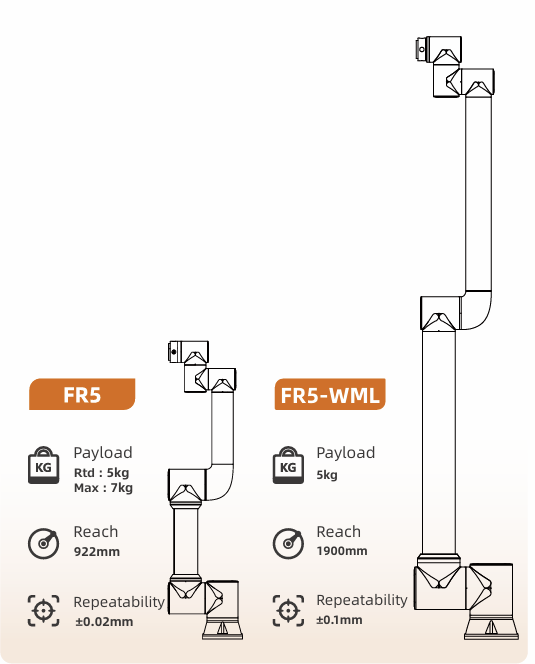
Typical fits: light assembly, inspection and pick-and-place, laboratory handling, small machine tending with a compact robot such as the FR3 or FR5.
When you still need a fence or a scanner
Be honest about the applications where an open cell is the wrong call:
- Welding. Arc radiation, spatter and fume need screening regardless of how the robot moves.
- Sharp, hot or heavy parts. The robot may be force limited, but a knife blade travelling at 200 mm/s is still a knife blade.
- High payload and long reach. Palletising with a FR20 or FR30 at real production speed puts a lot of energy in motion.
- Spindles, saws and other dangerous tools. The hazard is the tool, not the arm.
- Ejected parts or dropped loads. A vacuum gripper that loses air still drops the box.
A fence is not a failure. Very often the right design is a partial guard on the hazardous side and an open, scanner-monitored side where the operator works.
The middle ground most cells end up in
In practice, few real installations are purely fenceless or fully caged. The usual layout looks like this:
- Fixed guards or panels around the machine the cobot serves, and along walls
- A safety laser scanner covering the operator approach, with a warning zone that slows the robot and a protective zone that stops it
- Power and force limiting as a second layer for the moments a person is legitimately close
- Full speed for the long transfer moves where nobody can be present
This mixed approach keeps the cycle time defensible and still passes a cobot safety fence risk assessment, because the protection matches the hazard at each point in the cycle rather than everywhere at once.
Practical tips that save money later
- Include the gripper and the workpiece when you calculate payload and energy, not just the robot rating. Our guide on payload and reach shows how to add that up.
- Design pinch points out of the layout before you buy safety hardware.
- Measure stopping distance in the real cell, loaded, at the speed you will actually run.
- Involve the operators early. A cell that feels unsafe gets bypassed, and a bypassed safeguard protects nobody.
- Plan for maintenance and teaching, not only for normal production. That is when people get closest to the robot.
- Keep the assessment as a living document and revisit it whenever the tool, the part or the speed changes.
Frequently asked questions
Do collaborative robots legally require a safety fence?
No standard requires a fence by default. What is required is a risk assessment of the complete application, and its outcome decides whether guarding, a scanner, reduced speed or nothing extra is needed.
Is a risk assessment mandatory even for a simple pick-and-place cell?
Yes. Any machine placed on the European market needs a risk assessment and CE marking, however small the cell. A simple application just means the assessment is short.
Does a laser scanner replace a fence?
It can, for the side where people approach, using speed and separation monitoring. It does not help against hazards that a fence blocks physically, such as spatter, ejected parts or a dangerous tool.
Does running fenceless slow the robot down?
Usually yes, near people. That is why most cells run full speed when the area is clear and reduce speed only inside the monitored zone, which keeps the throughput loss small.
Talk it through before you buy
Safety is easiest and cheapest to solve at the layout stage. If you are sizing a first cell, browse the range on our products page, look at how existing installations are guarded in our customer cases, and then request a quote so we can size the robot, tooling and safety hardware together. Questions about a specific application? Contact the TMC Robotics team and we will go through it with you.
This article is general guidance, not a substitute for a documented risk assessment carried out for your specific installation.
