
Fairino FR5-WML vs FR20: Which Long Reach Cobot Do You Need?
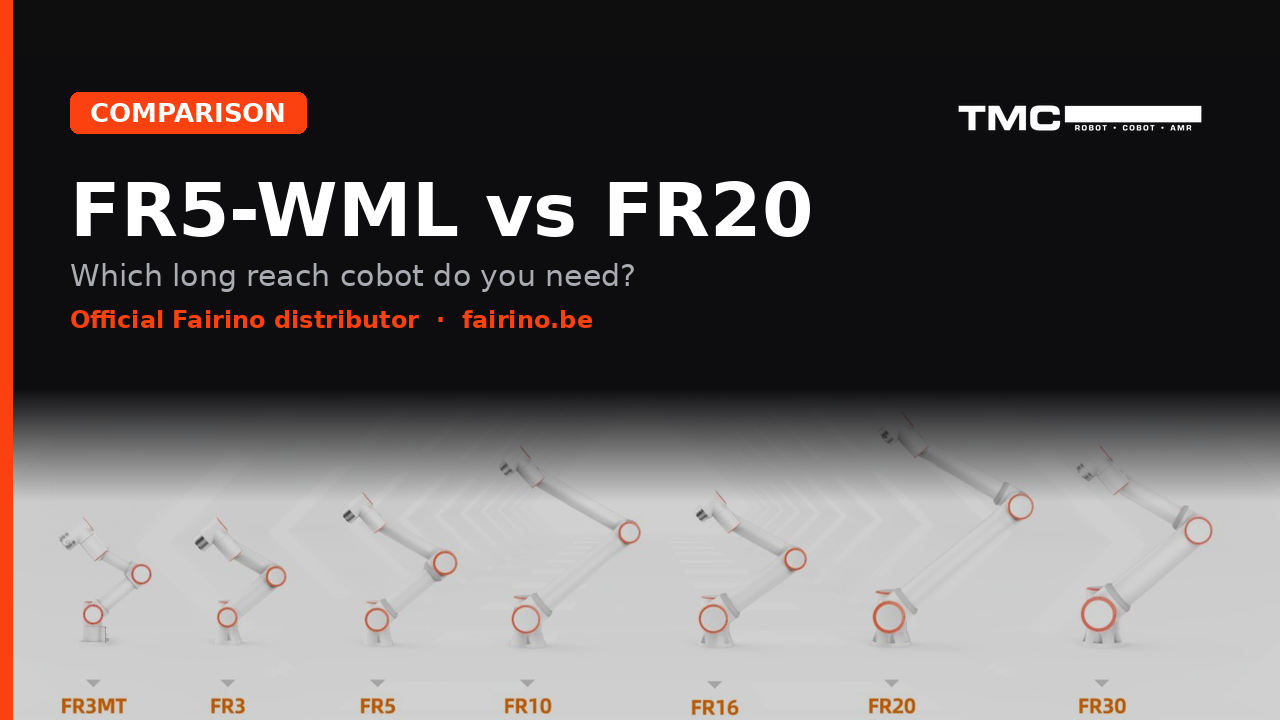
Fairino FR5-WML vs FR20: Which Long Reach Cobot Do You Actually Need?
The short version: take the FR5-WML if your parts are light and far apart. It carries 5 kg and reaches 1900 mm from a base that's only 190 mm wide. Take the FR20 if your parts are heavy. It carries 20 kg over 1854 mm and it's built for palletizing. The reach is basically the same on both. Everything else isn't.
These are the two longest arms Fairino makes, so people compare them all the time. Usually it's someone who has just worked out that a normal 900 mm cobot can't cover their cell. Below is what actually separates the two, where each one wins, and the costs that don't show up on the datasheet.
FR5-WML vs FR20: the specs side by side
| Specification | Fairino FR5-WML | Fairino FR20 |
|---|---|---|
| Payload | 5 kg | 20 kg |
| Reach | 1900 mm | 1854 mm |
| Repeatability (ISO 9283) | ±0.1 mm | ±0.1 mm |
| Degrees of freedom | 6 rotating joints | 6 rotating joints |
| Max. TCP speed | 2 m/s | 2.5 m/s |
| Robot weight | ≤ 45 kg | ± 64 kg |
| Protection rating | IP54 (IP65 optional) | IP54 (IP65 optional) |
| Recommended controller | AC MINI 2kW / DC MINI 2kW | AC 5kW / DC 5kW |
| Communication | TCP/IP, Modbus TCP/RTU. Optional: PROFINET, EtherCAT, EtherNet/IP, CC-Link | TCP/IP, Modbus TCP/RTU. Optional: PROFINET, EtherCAT, EtherNet/IP, CC-Link |
| SDKs | C#, C++, Python, Lua, ROS, ROS2. No licence fees | C#, C++, Python, Lua, ROS, ROS2. No licence fees |
| Certification | CE, ISO 10218, ISO/TS 15066 | CE, ISO 10218, ISO/TS 15066 |
| Price | On request | On request |
Both arms sit in stock in Ypres, Belgium. Both are quoted as a full package: arm, controller, software and startup support, no licence fees.
The reach is a tie, so stop looking at it
There are 46 mm between the two envelopes. That difference will never decide your layout. It disappears in the tolerance of where you bolt down the pedestal. So put the reach aside and go weigh the part.
Weigh everything that hangs on the flange, not just the part. Gripper, tool changer, cables, camera. A 3 kg part with a 1.5 kg gripper and a 0.5 kg changer already sits at the 5 kg ceiling of the FR5-WML, with nothing left over. If your heaviest variant is a 4 kg casting, you're not looking at an FR5-WML. You're looking at an FR20.
It works the other way too. Moving 1.2 kg boxes along a conveyor with an FR20 means you paid for 15 kg of payload you'll never touch, plus a 5 kW controller and a 64 kg arm that needs a heavier base under it.
Where the FR5-WML wins
The FR5-WML exists to get a seventh axis out of your budget. 1900 mm is about as long as cobot arms get, and one of them can cover work that would otherwise need a linear rail, a second robot, or a big industrial arm behind a fence.
- Tending several machines. Two or three CNC machines, one arm in the middle, no track.
- Long conveyors and oversized fixtures. Reach across the belt instead of moving the belt.
- Cold or awkward spots. It's rated from minus 20 °C up to 45 °C, so loading docks, cold stores and unheated halls are fine.
- Tight floors. A 190 mm base and an arm under 45 kg. You can move it, remount it, or put it on a mobile platform.
- Low power draw. Around 270 W average and 620 W peak, on a 2 kW MINI controller.
At 2 m/s it turns that reach into cycle time instead of spending it. What it won't do is lift a 10 kg bag.
Where the FR20 wins
Reach is what kills most palletizing projects. A shorter arm needs a lifting column to get to the top layer of a Euro pallet, and then the budget doubles. The FR20 covers the usual stacking patterns straight from a fixed pedestal, so the cell stays simple and small.
- Palletizing. Boxes, bags and bundles up to 20 kg, full pallet height, no lifting column.
- Big parts. Castings, sheet stacks, crates. The kind of thing a 5 kg arm can't touch.
- End of line. 2.5 m/s and ±0.1 mm, cycle after cycle.
- Mobile or battery powered cells. The 5 kW DC controller runs straight off a battery.
The costs that aren't on the datasheet
Three things change when you move up to the FR20, and they belong in the comparison.
- The controller. The FR5-WML runs on the 2 kW AC MINI or DC MINI. The FR20 needs the 5 kW AC or DC controller. Different cabinet, different power feed.
- The mount. 64 kg of arm swinging 20 kg at 2.5 m/s puts real force into the base. Plan a proper pedestal or a reinforced frame. Not a workbench.
- The risk assessment. Both arms are collaborative and certified to ISO 10218 and ISO/TS 15066. But a heavier payload moving faster raises the forces you have to account for. Expect more speed and separation zones around an FR20 palletizer, maybe even a fence, than around an FR5-WML feeding a lathe.
None of that is a reason to avoid the FR20. It's a reason not to buy one you don't need.
Three questions and you're done
- What's the total mass on the flange? Part, gripper, changer, cables. Over 5 kg, take the FR20. Comfortably under it, take the FR5-WML.
- Do you need to reach the top of a pallet, or across a cell? Pallet means FR20. Across machines means FR5-WML.
- How much power and floor space do you have? A mobile base, a battery or a crowded hall pushes you toward the lighter, lower power FR5-WML.
If your answer to the first question is "somewhere around 5 kg", assume you'll bolt on a heavier gripper within two years and take the FR20. If it's "under 3 kg, but it's a long way over there", the FR5-WML is the arm that saves you a seventh axis.
And if neither one fits?
The range doesn't stop at these two. The FR10 (10 kg, 1400 mm) sits between them and handles a surprising amount of machine tending. The FR16 and FR30 go heavier. For short, precise work the FR3 and FR5 give you ±0.02 mm at 622 mm and 922 mm, which is an order of magnitude tighter than either long reach arm. The full Fairino range is here.
Frequently asked questions
What is the difference between the Fairino FR5-WML and the FR20?
The FR5-WML carries 5 kg over 1900 mm and weighs under 45 kg. The FR20 carries 20 kg over 1854 mm and weighs about 64 kg. Both have 6 rotating joints and ±0.1 mm repeatability. The FR5-WML uses a 2 kW MINI controller, the FR20 a 5 kW one. The reach is effectively equal, so payload, speed and controller are what separate them.
Which Fairino cobot is best for palletizing?
The FR20. Its 20 kg payload and 1854 mm reach cover a full Euro pallet from a fixed pedestal, without a lifting column, at up to 2.5 m/s.
Which Fairino cobot has the longest reach?
The FR5-WML, at 1900 mm. That's among the longest on the cobot market. The FR20 follows closely at 1854 mm.
Can the FR5-WML replace a robot on a linear rail?
Often, yes. Up to 5 kg, its 1900 mm envelope covers several machines, long conveyors and oversized fixtures from one 190 mm base. That removes the cost and the maintenance of a seventh axis.
Do the FR5-WML and FR20 use the same controller?
No. The FR5-WML runs on the AC MINI 2kW or DC MINI 2kW. The FR20 needs the AC 5kW or DC 5kW. The DC versions can run off battery power for mobile platforms.
Can I program both in Python or ROS?
Yes. Both ship with SDKs for Python, C++, C#, Lua, ROS and ROS2, with no licence fees. There's also a browser based WebApp for no code programming and hand guided teaching.
What do the Fairino FR5-WML and FR20 cost?
Both are priced on request. You get an official quote from TMC Robotics within 24 hours, always as a full package: arm, controller, software and startup support, no licence fees.
Where can I buy the FR5-WML or FR20 in Europe?
From TMC Robotics, official Fairino core distributor. Both ship from stock in Ypres, Belgium, with short lead times across the EU.
Still not sure?
Send us the part weight, the gripper you have in mind and a sketch of the cell. We'll tell you which arm fits. And if a shorter, cheaper one does the job, we'll say that too. Compare them here: Fairino FR5-WML and Fairino FR20.
