
Fairino FR3 Series Overview | FR3 vs FR3-C vs FR3-WMS vs FR3-WML
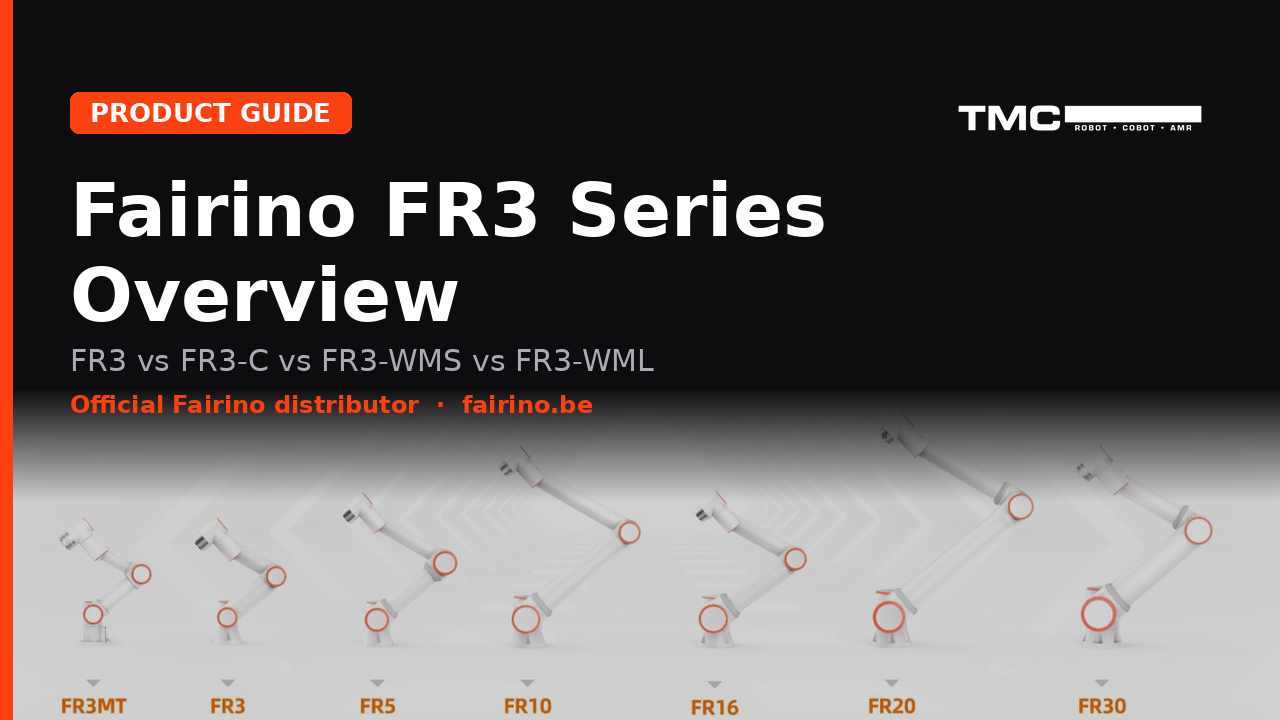
The Fairino FR3 series: FR3, FR3-C, FR3-WMS and FR3-WML
The Fairino FR3 series is a family of 6 axis cobots, all rated for 3 kg. They are built for work that needs compact integration, precise motion and a bit of flexibility in where you put them.
There are four versions:
They share the same 6 joint architecture. What changes is reach, wrist rotation, mechanical layout and power draw. This page walks through those differences and helps you pick.
What all FR3 models share
Payload: 3 kg
Degrees of freedom: 6 rotating joints
Typical TCP speed: 1 m/s
Aluminium and steel construction
Operating temperature: 0 to 45 °C
Operating humidity: 90% RH, non condensing
Because the platform is shared, the programming logic, the integration approach and the mechanical reliability are the same across the range.
Fairino FR3: the standard
Reach: 622 mm
Repeatability: ±0.02 mm
Axis 6 rotation: ±175°
Typical average power: 220 W
Weight: about 15 kg
Protection: IP54, IP65 optional
The standard FR3 suits general work: pick and place, light assembly, machine tending, part handling. High precision, balanced motion, compact envelope.
Fairino FR3-C: compact and light
Same 3 kg and same 622 mm as the standard FR3, but built for tight integration.
Wrist 2 rotation: 0° to 355° instead of ±175°
Weight: about 10 kg
Footprint: 125 mm
Repeatability: ±0.05 mm
Typical average power: 200 W
Take the FR3-C when the robot itself has to be light, when mounting space is scarce, or when that extra wrist travel helps you position the tool. It fits cramped cells and mobile platforms.
Fairino FR3-WMS: full wrist rotation, low power
Same 622 mm and ±0.02 mm as the FR3, but with a wrist that turns further and a much lower power draw.
Axis 6 rotation: ±360°
Typical average power: 90 W
Typical peak power: 130 W
Weight: about 10.5 kg
That ±360° gives the tool more rotational freedom, which helps on round or tubular parts. The low power draw pays off in energy sensitive plants, on battery powered or mobile systems, and anywhere you want less heat in the cell.
Fairino FR3-WML: long reach, full wrist rotation
Reach: 922 mm instead of 622 mm
Axis 6 rotation: ±360°
Repeatability: ±0.05 mm
Weight: about 11.25 kg
Typical average power: 140 W
The extra 300 mm gives you a bigger workspace, easier access into machines and better coverage of a cell. Combined with the ±360° wrist, this is the variant for work that needs both room and rotation.
Short summary
FR3: the balanced one, highest repeatability, standard wrist limits.
FR3-C: lighter and more compact, extra travel on wrist 2.
FR3-WMS: full ±360° on axis 6 and a much lower power draw.
FR3-WML: the long reach one, with full ±360° on axis 6.
None of them change the payload. They each solve a different mechanical or integration problem.
Which one do you need?
- How far does it have to reach?
- Do you need full rotation on wrist 2 or axis 6?
- Are you limited on power?
- Is there a weight limit on the mount?
- How tight does the repeatability have to be?
For compact work with little reach, the FR3 or FR3-C is enough. If you need a wrist that turns all the way around, take the FR3-WMS or FR3-WML. And if you need the workspace, the FR3-WML is the only one with 922 mm.
All four are available in Europe through TMC Robotics. The standard FR3 starts at €4,600 excl. VAT, controller and licence free software included. Not sure which one fits your cell? Request a quotation or book a demo in our 400 m² experience centre in Ypres, Belgium.
